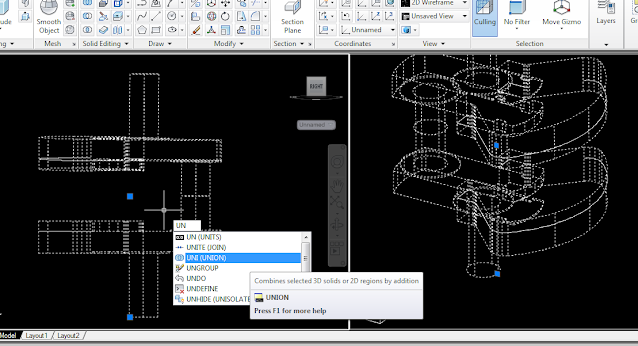
Step by step process to create crank shaft 3D component using AutoCAD

Also Read


1. Start AutoCAD and create new autocad document with acd3D template.
2. Now draw the right side view on xy plane like shown below.


3. With help of press pull tool extrude the closed areas.


4. Now union the individual extrusions. and mirror it then again union the mirrored parts.


5. Now apply the colors.


Orthographic Projection of crank shaft of single cylinder engine with dimensions.

Back to AutoCAD all lessons

Comments

Recent posts

Isometric drawings for practice in AutoCAD

What is Isometric Drawing? Isometric drawing is a method of visually representing three-dimensional objects in two dimensions. It allows for a clear and comprehensive depiction of complex structures by keeping the scale consistent and eliminating distortion. Isometric drawings use a 30-degree angle from the horizontal in all three axes (X, Y, and Z), creating a pseudo-3D effect where the height, width, and depth are equally foreshortened. Creating Isometric Drawings in AutoCAD AutoCAD provides tools and settings that make creating isometric drawings straightforward. Here’s a step-by-step guide: Step 1: Set Up Isometric Snap/Grid 1. Enable Isometric Snap/Grid:    - Type `SNAP` in the command line and press `Enter`.    - Type `Style` and press `Enter`.    - Choose `Isometric` and press `Enter`. 2. Switch Between Isoplanes:    - Type `F5` or `CTRL+E` to toggle between the top, right, and left isoplanes. Step 2: Draw Isometric Circles and Arcs 1. Isom...

SINGLE ‘V’ BUTT JOINT

Experiment No.:                                                                                      Date: SINGLE ‘V’ BUTT JOINT Aim: To prepare a single ‘V’ Butt Joint as per dimensions given in the sketch. Material Required: Mild Steel plates: 80mm X 40mm X 6mm = 2 Nos Mild Steel electrode ¢ 3.15 mm Equipment required: A.C. Transformer with all welding accessories like Electrode holder, cables. Tool Required: Steel rule 300mm  Scriber 150mm Flat file 300mm Try square 200mm Flat Tong 450mm  Chipping hammer 200mm Ball peen hammer 750mm  Wire brush Welding screen Sequence of Operations: 1. Marking  2. Filing  3. Welding  4. Finishing Procedure: Take two Mild steel plates of size 80mm X 40mm X 6mm. Fix the wor...

Fluid mechanics VIVA QUESTIONS and ANSWERS

1. Define density? Ans: It is defined as the ratio of mass per unit volume of the fluid. 2. Define viscosity? Ans: It is defined as the property of fluid which offers resistance to the movement of fluid over another adjacent layer of the fluid. 3. Differentiate between real fluids and ideal fluids? Ans: A fluid, which is in-compressible and is having no viscosity, is known as ideal fluid while the fluid, which possesses viscosity, is known as real fluid. 4. What is a venturimeter? Ans: It is a device which is used for measuring the rate of flow of fluid flowing through pipe. 5. What is a notch? Ans: A notch is a device used for measuring the rate of flow of a fluid through a small channel or a tank. 6. Define buoyancy? Ans: When a body is immersed in a fluid, an upward force is exerted by the fluid on the body. This upward force is equal to the weight of the fluid displaced by the body. 7. Define meta-centre? Ans: It is defined as the point about which a body...

Welding VIVA question and answers

VIVA QUESTIONS : Q1: Define welding? Ans:  Welding is a fabrication process that joins two or more materials, typically metals or thermoplastics, by melting and fusing them together using heat or pressure. Q2: What is the typical thickness of MS Plate used in general welding workshop experiments? Ans:  The thickness of the MS (Mild Steel) plate used in general welding workshop experiments can vary depending on the specific requirements of the experiment. However, commonly used thicknesses range from 3 mm to 12 mm. Q3: What is the common job material used in welding experiments? Ans:  The common job material used in welding experiments is mild steel. It is widely available, affordable, and relatively easy to work with, making it suitable for various welding applications and practice. Q4: What is the main function of an electrode in welding? Ans:  The main function of an electrode in welding is to carry the electric current necessary for the welding process and to ...

step by step procedure to draw hook 2D drawing using AutoCAD

1. Create one vertical line and two horizontal lines like shown below according to dimensions. 2.Draw the circles at intersecting points like shown below with given dimensions. 3. Draw TTR (tangent tangent Radius) circles like shown below with given radius values. 4. Trim extra elements using " TR " command the final image be shown like below. 5. Now draw another reference lines and circles using TTR(tangent tangent Radius) circle according to given dimensions. 6. Now Trim the extra elements by using "TR" command. 7. Now dimension the elements using DIM command.

Step by step procedure to insert 3rd Angle Projection symbol in Solidworks

Step 1: open solidworks drawing tool with default or your required sheet size. Then the object view in paper space. Step 2: 1. Click on Annotation tab and select "Note". 2. Then add the note at title block. 3. Then click on add symbol in properties manager. 4. Then click on add more symbols. Step 3: Check the symbol in symbol library categories. if you found the symbol then click on "OK" button. if you not found the 3rd angle projection in the symbol library categories then see the Step 4 in this page. Step 4: 1. Go to this file location from your computer by pasting the below in your windows explorer or browse from your computer or search "gtol.sym" and open the file location by using right clicking on the searchable file. C:\ProgramData\SOLIDWORKS\SOLIDWORKS 2019\lang\english 2. Then copy the "gtol.sym" file then paste this file in anywhere you like. here i'm pasting this file in desktop > Solidworks > pr...

Welding-LAP JOINT

Ex. No :                                                                              Date : LAP JOINT Aim To join the given two work pieces as a lap joint by arc welding. Material used Mild Steel plates. Tools required Welding power supply  Flat file Welding rod Chipping hammer Electrode holder Wire brush Gloves and apron Earthing clamps Shield and goggles Procedure The given workpieces are thoroughly cleaned, i.e. rust, scales are removed and the  edges are filed. The electrode is held in an electrode holder and ground clamp is clamped to the  welding plates and the power is supplied. The workpieces are positioned on the table to form a “Lab joint”. The tag weld is done on the both the ends of joining plates to avoid the m...

Calibration of pressure gauge using dead weight tester

Aim : On completion of this unit you will be able to check the accuracy of a Bourdon tube pressure gauge using dead weight tester. Theory : Many types of gauges are available for measurement of pressure. The Bourdon gauge (named after its inventor Bourdon) uses the deflection of a tube of oval cross-section to cause a pointer to move over a scale. Because of its simplicity and low cost, and the large selection of pressure ranges, which are available, the Bourdon gauge is widely used engineering practice. All pressure gauges, of whatever type, needs to be calibrated. As the calibration may change over a period, repeat calibrations may well be needed from time to time. The normal calibration procedure is to load the gauge with known pressures, using a dead weight tested using oil. The present experiment, however, works satisfactorily with oil. In this experiment we check the accuracy of the Bourdon Tube pressure gauge. The procedure will be to calibrate the gauge by applying weight...
PLUMBING Introduction Plumbing deals with the laying of a pipeline. A craftsman may be perfectly proficient with the hammer, saw and other tools, but the faces difficulties with leaking pipes and overflowing toilets. Many people rush to a plumber on seeking a tripping pipe, but a person with a little knowledge of the sanitary system can control this problem easily, saving time and, one with help of few tools. Plumbing tools The tools used by a plumber can be classified as follows Pipe wrench  Pipe vice Pipe cutter Hacksaw  Dies Files and Rasps Plumb bob Pipe wrench A pipe wrench is used for holding and turning the pipes, rods and machine prts. Wrenches are classified as follows. 1.Fixed wrenches  2. Adjustable wrenches. Pipe vice A pipe vice is fitted on the work bench. This has a set of jaws to grip the pipe and prevent it from turning while cutting, threading and fitting of bends, couplings etc. The yoke vice is co...

Welding introduction

WELDING Introduction : Welding is a process of joining two similar or dissimilar metals by the application of heat with or without application of pressure and addition of filler material. The welding is extensively used in manufacturing industry, construction industry and maintenance work, replacing riveting and bolting, to a greater extent.  The various welding processes are 1. Electric arc welding 2. Gas welding 3. Thermit welding 4. Resistance welding and 5. Friction welding However only electric arc welding is discussed here. In this process, the work pieces are melted along a common edge, to their melting point and then a filler metal is introduced to form the joint on solidification. The materials to be welded must be free from rust, scale oil or other impurities, so as to obtain a sound weld. Arc Welding: In arc welding, the heat required for joining the metals is obtained from an electric arc. Transformers or motor generator sets are used as arc welding ma...

Search This Blog