step by step procedure to create 3D drawing by using AutoCAD

Also Read

3-Dimensional Practice parts

1. First see The Dimension's of the 3-Dimensional component by using it's given orthographic views.
The below image represents orthographic drawing of the 3-Dimensional component.
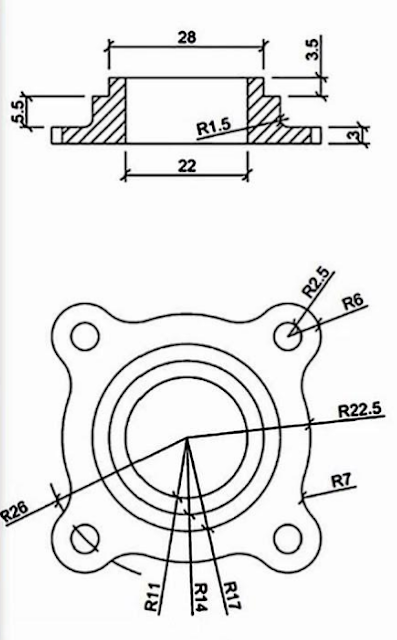
Orthographic view of the 3D component


2. Now open AutoCAD and set 3D modeling as workspace, then start drawing in XY plane (by default).
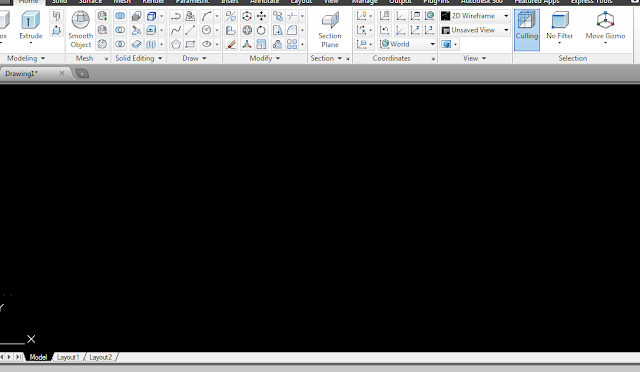
AutoCAD 3D workspace

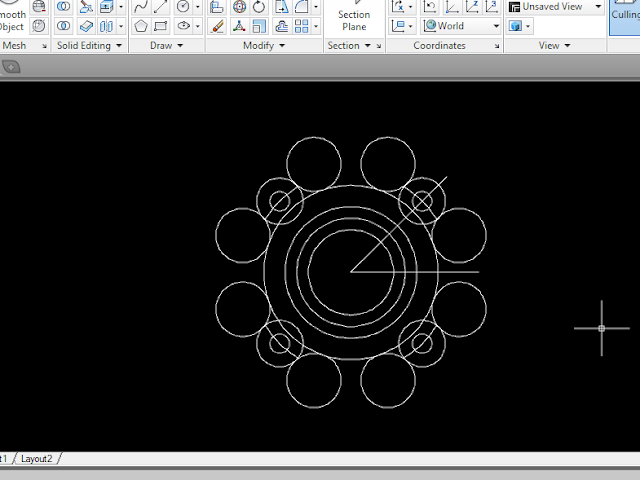
3. Now draw the Circles like shown below by using CIRCLE(C) command. 

Circle's drawing for biginners

4. Now to make 45 degrees angle corner point, Draw a line with 45 degrees.

Circle's drawing for biginners

5. Now take the corner point as reference and create 2 circles with given radius values.

Circle's drawing for biginners

6. Now select lastly selected circles and make mirror to horizontal, then select total 4 circles and mirror vertically with MIRROR (MI) command.


AutoCAD 3D practice drawings

7. Now TRIM the extra elements with TRIM(TR) command.
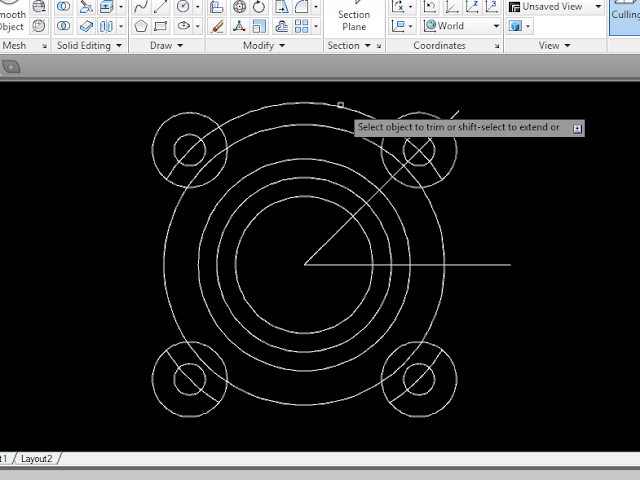
step by step procedure to create 3D drawing in AutoCAD

8. Now create circles with Tangent Tangent Radius option like shown below.

AutoCAD 3D practice drawings

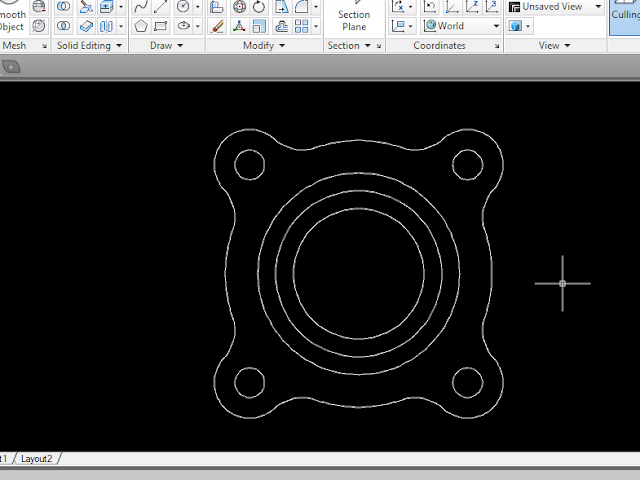
9. Now TRIM extra elements with TRIM (TR) command.

step by step procedure to create 3D drawing in AutoCAD

step by step procedure to create 3D drawing in AutoCAD

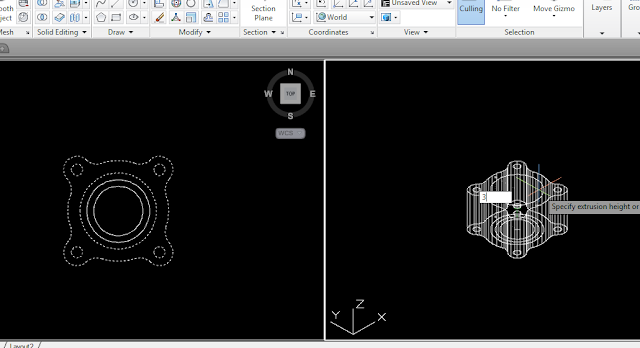
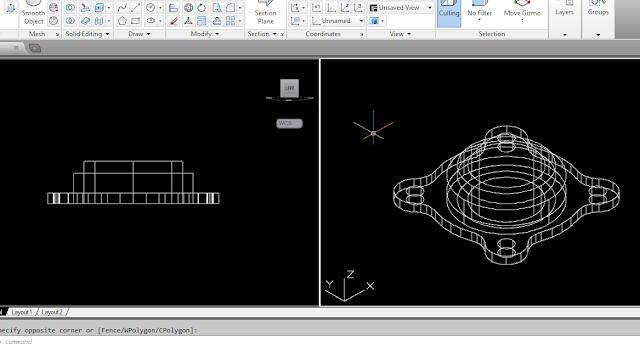
10. Now split the workspace as two vertical layouts and change the orientation of drawing in one layout.
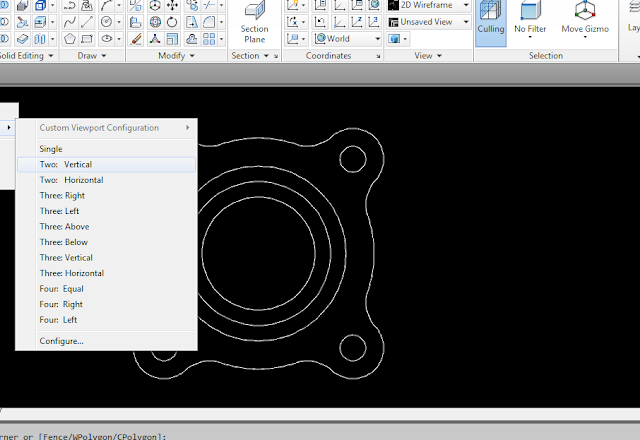
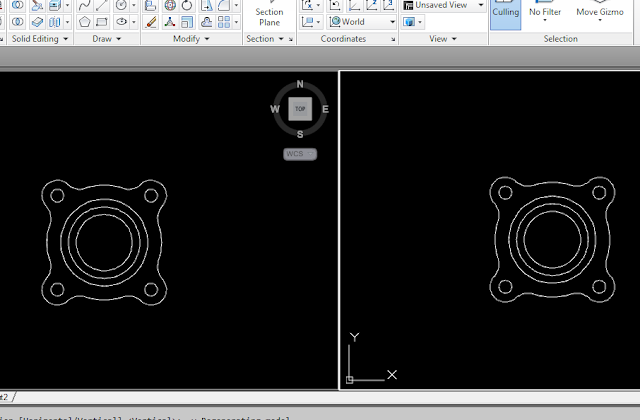
step by step procedure to create 3D drawing in AutoCAD

step by step procedure to create 3D drawing in AutoCAD

11. Now extrude the three different closed areas with different height's as like shown in the orthographic projection by using Press-pull tool.
step by step procedure to create 3D drawing in AutoCAD

step by step procedure to create 3D drawing in AutoCAD

step by step procedure to create 3D drawing in AutoCAD

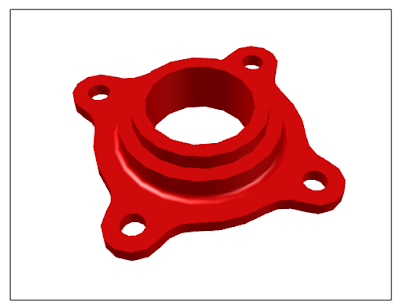
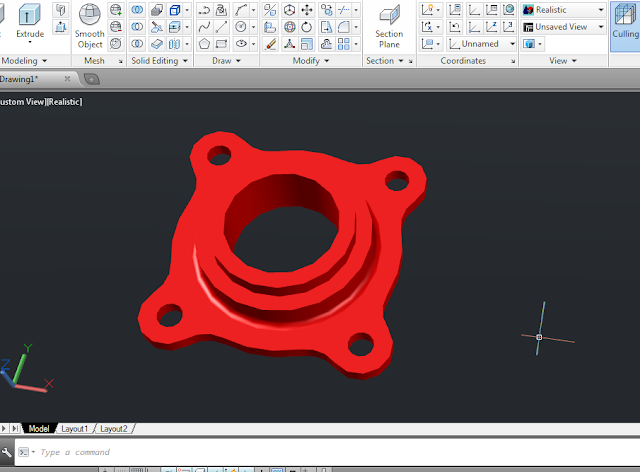
12. Now join the extruded individual bodies into one single body by using UNION tool. Then apply the color from layer properties.

step by step procedure to create 3D drawing in AutoCAD


Back to AutoCAD all lessons

Comments

Recent posts

Isometric drawings for practice in AutoCAD

What is Isometric Drawing? Isometric drawing is a method of visually representing three-dimensional objects in two dimensions. It allows for a clear and comprehensive depiction of complex structures by keeping the scale consistent and eliminating distortion. Isometric drawings use a 30-degree angle from the horizontal in all three axes (X, Y, and Z), creating a pseudo-3D effect where the height, width, and depth are equally foreshortened. Creating Isometric Drawings in AutoCAD AutoCAD provides tools and settings that make creating isometric drawings straightforward. Here’s a step-by-step guide: Step 1: Set Up Isometric Snap/Grid 1. Enable Isometric Snap/Grid:    - Type `SNAP` in the command line and press `Enter`.    - Type `Style` and press `Enter`.    - Choose `Isometric` and press `Enter`. 2. Switch Between Isoplanes:    - Type `F5` or `CTRL+E` to toggle between the top, right, and left isoplanes. Step 2: Draw Isometric Circles and Arcs 1. Isom...

Fluid mechanics VIVA QUESTIONS and ANSWERS

1. Define density? Ans: It is defined as the ratio of mass per unit volume of the fluid. 2. Define viscosity? Ans: It is defined as the property of fluid which offers resistance to the movement of fluid over another adjacent layer of the fluid. 3. Differentiate between real fluids and ideal fluids? Ans: A fluid, which is in-compressible and is having no viscosity, is known as ideal fluid while the fluid, which possesses viscosity, is known as real fluid. 4. What is a venturimeter? Ans: It is a device which is used for measuring the rate of flow of fluid flowing through pipe. 5. What is a notch? Ans: A notch is a device used for measuring the rate of flow of a fluid through a small channel or a tank. 6. Define buoyancy? Ans: When a body is immersed in a fluid, an upward force is exerted by the fluid on the body. This upward force is equal to the weight of the fluid displaced by the body. 7. Define meta-centre? Ans: It is defined as the point about which a body...
PLUMBING Introduction Plumbing deals with the laying of a pipeline. A craftsman may be perfectly proficient with the hammer, saw and other tools, but the faces difficulties with leaking pipes and overflowing toilets. Many people rush to a plumber on seeking a tripping pipe, but a person with a little knowledge of the sanitary system can control this problem easily, saving time and, one with help of few tools. Plumbing tools The tools used by a plumber can be classified as follows Pipe wrench  Pipe vice Pipe cutter Hacksaw  Dies Files and Rasps Plumb bob Pipe wrench A pipe wrench is used for holding and turning the pipes, rods and machine prts. Wrenches are classified as follows. 1.Fixed wrenches  2. Adjustable wrenches. Pipe vice A pipe vice is fitted on the work bench. This has a set of jaws to grip the pipe and prevent it from turning while cutting, threading and fitting of bends, couplings etc. The yoke vice is co...

SINGLE ‘V’ BUTT JOINT

Experiment No.:                                                                                      Date: SINGLE ‘V’ BUTT JOINT Aim: To prepare a single ‘V’ Butt Joint as per dimensions given in the sketch. Material Required: Mild Steel plates: 80mm X 40mm X 6mm = 2 Nos Mild Steel electrode ¢ 3.15 mm Equipment required: A.C. Transformer with all welding accessories like Electrode holder, cables. Tool Required: Steel rule 300mm  Scriber 150mm Flat file 300mm Try square 200mm Flat Tong 450mm  Chipping hammer 200mm Ball peen hammer 750mm  Wire brush Welding screen Sequence of Operations: 1. Marking  2. Filing  3. Welding  4. Finishing Procedure: Take two Mild steel plates of size 80mm X 40mm X 6mm. Fix the wor...

Welding-LAP JOINT

Ex. No :                                                                              Date : LAP JOINT Aim To join the given two work pieces as a lap joint by arc welding. Material used Mild Steel plates. Tools required Welding power supply  Flat file Welding rod Chipping hammer Electrode holder Wire brush Gloves and apron Earthing clamps Shield and goggles Procedure The given workpieces are thoroughly cleaned, i.e. rust, scales are removed and the  edges are filed. The electrode is held in an electrode holder and ground clamp is clamped to the  welding plates and the power is supplied. The workpieces are positioned on the table to form a “Lab joint”. The tag weld is done on the both the ends of joining plates to avoid the m...

Step by step procedure to insert 3rd Angle Projection symbol in Solidworks

Step 1: open solidworks drawing tool with default or your required sheet size. Then the object view in paper space. Step 2: 1. Click on Annotation tab and select "Note". 2. Then add the note at title block. 3. Then click on add symbol in properties manager. 4. Then click on add more symbols. Step 3: Check the symbol in symbol library categories. if you found the symbol then click on "OK" button. if you not found the 3rd angle projection in the symbol library categories then see the Step 4 in this page. Step 4: 1. Go to this file location from your computer by pasting the below in your windows explorer or browse from your computer or search "gtol.sym" and open the file location by using right clicking on the searchable file. C:\ProgramData\SOLIDWORKS\SOLIDWORKS 2019\lang\english 2. Then copy the "gtol.sym" file then paste this file in anywhere you like. here i'm pasting this file in desktop > Solidworks > pr...

step by step procedure to draw hook 2D drawing using AutoCAD

1. Create one vertical line and two horizontal lines like shown below according to dimensions. 2.Draw the circles at intersecting points like shown below with given dimensions. 3. Draw TTR (tangent tangent Radius) circles like shown below with given radius values. 4. Trim extra elements using " TR " command the final image be shown like below. 5. Now draw another reference lines and circles using TTR(tangent tangent Radius) circle according to given dimensions. 6. Now Trim the extra elements by using "TR" command. 7. Now dimension the elements using DIM command.

Viva questions and answers about CNC (Computer Numerical Control)

Q1: What is CNC? A1: CNC stands for Computer Numerical Control. It is a technology that uses computerized systems to control machine tools and automate manufacturing processes. Q2: What are the advantages of CNC machining? A2: Some advantages of CNC machining include: Increased precision and accuracy in manufacturing. Improved efficiency and productivity. Greater flexibility in producing complex parts. Reduced human error and increased repeatability. Ability to automate manufacturing processes. Enhanced safety for operators. Q3: How does CNC differ from traditional machining? A3: CNC differs from traditional machining in that it uses computerized control systems to operate machine tools. Traditional machining relies on manual operation, while CNC machines can execute precise instructions based on digital design data. Q4: What are the primary components of a CNC system? A4: The primary components of a CNC system are: Machine tool: The physical equipment such as a lathe, mill, or router....

Sheet metal Funnel making

Making a Funnel using metallic sheet Making a Funnel using metallic sheet Aim:- To make a funnel from a given (GI)metallic sheet. Tools Required:- MALLET, SNIP, STAKE, STEEL RULE, BALL PEEN HAMMER, STRAIGHT EDGE, RIVETS, SCRIBER Procedure:  The size of the given sheet metal is checked for its dimensions using a steel rule The required development of surface is being made on the white paper which is overlapped on the sheet metal. The marking is done on the sheet metal as per the development being done on the paper. Now using straight snips, unwanted materials are removed. Now fold and bend the workpiece to make the funnel shape and joint is made on the workpieces. Then using a groover, a locked grooved joint is made for about 5mm. Also, hemming is done in the bottom of the funnel. In between top face and bottom face, a butt joint is made using a solder. Finally, trimming and finishing operations are carried out. Safety Precautions:- Each cut you make exposes s...

Welding-TEE FILLET JOINT

Ex. No :                                                                                 Date : TEE FILLET JOINT Aim To join the given two work pieces as a ‘Tee fillet joint’ by arc Welding. Material used Mild steel plates. Tools required • Welding power supply • Flat file • Welding rod • Chipping hammer • Electrode holder • Wire brush • Gloves and apron  • Earthing clamps • Shield and goggles Procedure The given workpieces are thoroughly cleaned, i.e. rust, scales are removed and the  edges are filed. The electrode is held in an electrode holder and ground clamp is clamped to the  welding plates and the power is supplied. The workpieces are positioned on the table to form a “Tee fillet joint”. The tag weld is done on the bo...

Search This Blog